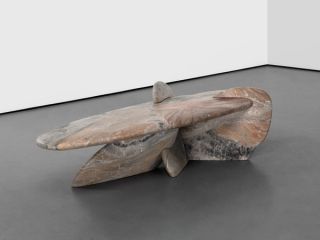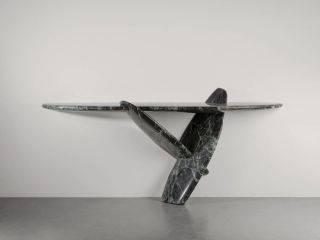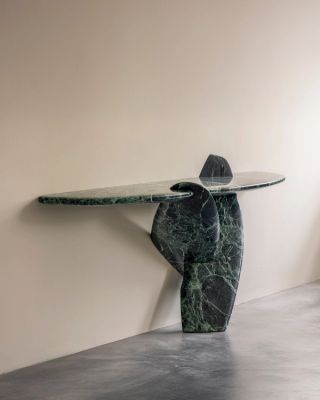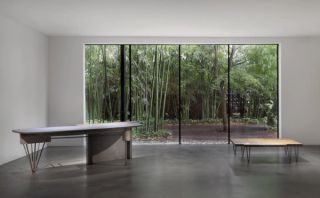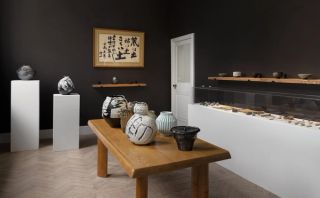
The exhibition begins on the ground floor of the gallery with the Fuse series, including a previously unseen console in a striking Alpi Green marble. As with much of Trevelyan’s recent work, Fuse stems from a desire to broaden the scope of his practice by setting aside a brief-led design approach to draw inspiration from structured experimentation in both material and process such that uncertainty and unfamiliarity become integral to the creation of the work. Derived initially from a thought experiment involving the fusion of simple forms to create structure, the evolution of this series was informed by both wooden puzzles from childhood and the construction of simple maquettes in which pins were used to temporarily assemble larger structures. Translating the concept from maquette to large sculptural pieces in marble and bog oak required a meticulous design process involving precise sculpting of curved geometries to enable the forms to slot together and lock. As such, the aesthetic simplicity belies a technical complexity and the series exemplifies a blend of sculptural elegance with structural precision.
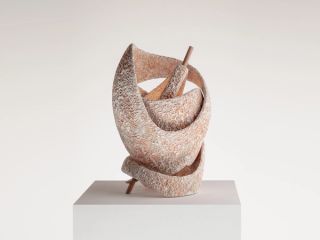
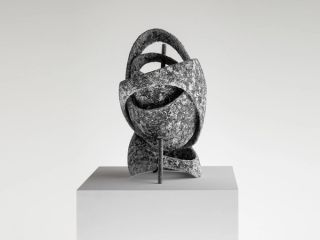
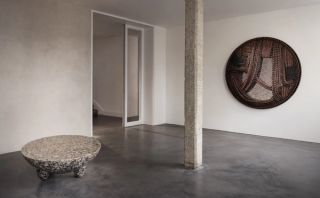
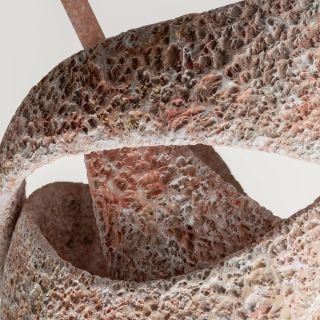
The exhibition continues on the first level of the gallery with works from the Gyre series that meld digital fabrication with meticulous hand-sculpting and finishing. Trevelyan has previously worked largely in bronze – in contrast Gyre features works that are characterised by a spontaneous painterly approach to the expression of both form and colour in the finished works. Elegantly looped structures of 3D printed sand and resin undergo a process in which thickened pigmented epoxy is built up in multiple layers over many days to build a surface patina in which colour and texture are interlinked. Cutting back the final surface reveals a stratigraphy of hues from palettes unique to each work that are drawn from personal experience. The accompanying maquettes are selected from various stages of the process, illustrating the exploration of form, texture and colour that informs the development of the works.
Despite their apparent differences in aesthetic and material, Gyre and Fuse share an underlying commonality in that both are assemblages of uniform morphologies. While Fuse merges simple pebble-like forms and Gyre consists of concentric hollow structures, both series explore the creation of structures in a manner that exhibits a coherence in their base sculptural language.