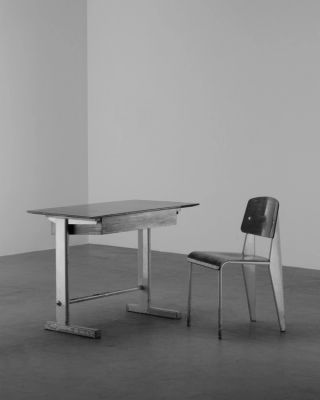
Jean Prouvé Black Dining Chairs Mod. 305 (Set of 12)
Price on request
Historical Design
1950
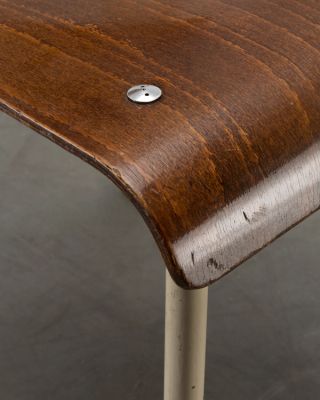
Enameled Steel, Beech Plywood, Aluminum
42 x 81 x 48 cm
16.5 x 31.9 x 18.9 in
“In my mind, a chair had to be light. A chair always breaks at the rear joint between the legs and the seat. This is the reason why all my pieces of furniture have forms of equal resistance.”
The Mod. 305 chair is based on human anatomy. At the back, the tension is stronger since it is the part that supports the weight of the torso. The back feet then carry most of the person's weight, hence their thickening. Their shape avoids the deformation caused by swinging. The chair gives an impression of stability and solidity while relying on simple shapes and materials. The structure is made of folded and lacquered sheet metal. The seat and the back are made of plywood.
Literature:
P. Sulzer, Jean Prouvé: Oeuvre Complète/Complete Works, Volume 2: 1933-1944, Basel 2005, pp. 34-35, 211-212.
Location: Paris
Artist
Jean Prouvé
Jean Prouvé (1901-1984) was a French metal worker and pioneering architect. He played a major role in the development of systems of mass production in post-war modernism. He began designing in 1924 after working in metallurgy and built his own factory in 1945 in Maxéville. Prouvé taught at the Conservatoire National des Arts et Matières and was elected a member of the Academy of Architecture in 1972. He built the Musée des Beaux Arts du Havre from 1951 to 1962.