


Joaquim Tenreiro Set of 6 Estoril Chairs
Price on request
Historical Design
circa 1960
Imbuia Wood, Cane
50.5 x 116.5 x 53.5 cm
19.9 x 45.9 x 21.1 in
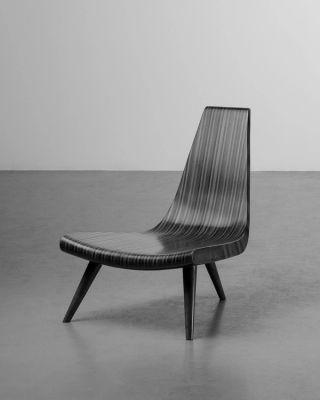
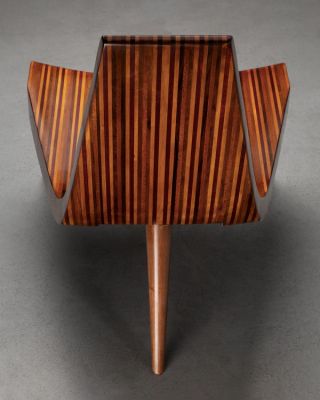
The Estoril chair was designed around 1947, at which time Tenreiro began to integrate straw in his furniture, mainly as cane for the seat or the backrest. This practice was a continuation of Brazilian tradition: straw has been used in Brazilian furniture for ventilation purposes and visual lightness for centuries. It can also be interpreted as related to German-Austrian designer Michael Thonet’s use of caning, as well as of Bauhaus artists such as Marcel Breuer. Despite the modernity of its lines, the high backrest continues a formal tradition of typical Brazilian dining chairs.
Literature:
M. C. Loschiavo dos Santos, Ed USP (ed.), Móvel Moderno no Brasil, São Paulo 1995, pp. 82, 84 (related example).
M. C. Loschiavo Dos Santos, Bolsa de Arte (ed.), Tenreiro, Rio de Janeiro 1998, p.132.
Aeroplano (ed.), Movel Brasileiro Moderno, São Paulo 2012, p. 53, 94.
Artist
Joaquim Tenreiro
Joaquim Tenreiro (1906-1992) is often referred to as the father of Brazilian modernism. The furniture designer was born in Portugal and moved to Rio de Janeiro in the late 1920s. In 1941, he received a commission to create furniture for a home designed by Oscar Niemeyer for the writer Francisco Inácio Peixoto. He designed modern furniture that fit the Brazilian style of life, often using native woods. He continued designing furniture until the late 1960s, when he then devoted himself to painting and sculpture.