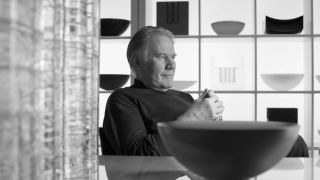
Vízner was born in Prague, Czechoslovakia in 1936. In 1951-53, he attended the Primary School of Glassmaking in Nový Bor, where he received an apprenticeship in glass painting. He then attended the Technical College of Glassmaking in Železný Brod. In 1956-62, Vízner studied at the Academy of Applied Arts in Prague in the glass and glyptics studio. In 1962-1977, Vízner was a designer at Sklo Union glassworks and Škrdlovice glassworks. During that period, he began shaping glass with a grindstone and collaborating with architects on public installations such as the 1981 glass tiling for the Prague underground or the light fittings for the Czech Parliament and National Theatre buildings. Vízner left the glass industry in 1975 to pursue a successful career as an independent artist. He set up his own studio in 1977, after which cut glass became the preliminary focus of his work.
Vízner was a solitary figure among glassmakers – a representative of seldom seen minimalism and concentrated development of a single theme. Throughout his career, he worked towards creating harmonious geometric objects instilled with internal tension. While his pieces are based on the shapes of functional bowls and plates, we understand their pure and simple volumes better as non-functional, sculptural forms. These timeless, minimalist creations demonstrate Vízner’s attention to proportion, admiration of glass material and, above all, high-quality craftwork.
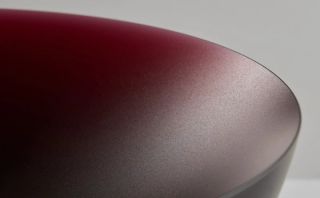
Vízner’s best known form is the bowl with a single, central peak. First made in 1971, this classic was a life-long preoccupation, with its variations resulting from careful consideration and the introduction of new colours. Technique was vital, as well as a deep understanding of the material. Vízner used the technique of cut glass – a practice very similar to the ancient technique of marble sculpture making. Transforming a solid glass block into an agile, light-transforming object was one of Vízner’s special skills. He cut, drilled and worked the glass into the sensuous, rhythmic contours that became his trademark. The surfaces were acid-etched to a matt finish. While his contemporaries in Czechoslovakia specialised in precision- cut, geometric, prismatic glass or in blown glass, freely formed and sometimes painted, sculptures, František Vízner steadfastly stayed with the vessel.
Vízner’s extraordinary objects, with their clean, articulated lines and deep, luminous colours, continue to impress collectors around the world and are represented in the most prominent museum collections: Museum of Applied Art and Craft in Prague, The Metropolitan Museum of Art in New York, Victoria and Albert Museum in London, Musée des Arts décoratifs in Paris, The Corning Museum of Glass National Museum of Modern Art in Tokyo and many others.