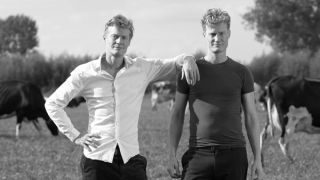
The Verhoeven Twins graduated from the Design Academy Eindhoven in 2004. Since then, their work has been exhibited internationally, with notable presentations including Against the Grain: Wood in Contemporary Art, Craft and Design at the Mint Museum, North Carolina, which travelled to the Museum of Arts and Design, New York (2013); New Energy in Design and Art, Museum Boijmans Van Beuningen, Rotterdam (2011); the solo exhibition The Curious Image, Blain|Southern, London (2011); Telling Tales, Victoria and Albert Museum, London (2009); Thing: Beware the Material World, Art Gallery of Western Australia, Perth (2009); Digitally Mastered: Recent Acquisitions, Museum of Modern Art, New York (2007); and Space for Your Future, Museum of Contemporary Art, Tokyo (2007).
Their practice has been widely discussed in publications including History of Design: Decorative Arts and Material Culture, 1400–2000 (Yale University Press, 2013); The Power of Design: Product Innovation in Sustainable Energy Technologies (Wiley, 2013); Glenn Adamson’s The Invention of Craft (Berg, 2012); 21st Century Design by Marcel Wanders and Marcus Fairs (Carlton Books, 2011); Design Dictionary: Perspectives on Design Terminology (Birkhäuser, 2008); And Fork edited by Tom Dixon (Phaidon Press, 2007); and Gareth Williams’ The Furniture Machine (Victoria and Albert Museum, 2006).
Their works are held in numerous public and private collections, including the Art Gallery of Western Australia, Perth; Brooklyn Museum, New York; Die Neue Sammlung, Munich; Museum of Modern Art, New York; Victoria and Albert Museum, London; Centre Pompidou, Paris; and most recently the Corning Museum of Glass, New York.
“We respect the old but want the new. We want to challenge and confront the normal, the accepted, the expected. We believe in fusing writers, filmmakers, artists, and scientists into a movement that goes beyond ego—to create a super storyteller. As designers, we are not limited to a single category. We work with museums, architecture, furniture, and fashion companies, as well as commercial brands and self-initiated projects. Whatever the starting point, our aim is always to create products that are both challenging and beautiful.
Dutch Design is renowned for its conceptual, almost art-like approach. We are very much Dutch, but we also strongly believe that our work should ultimately reach a wider audience. That is why we operate in a way similar to the haute couture fashion world.
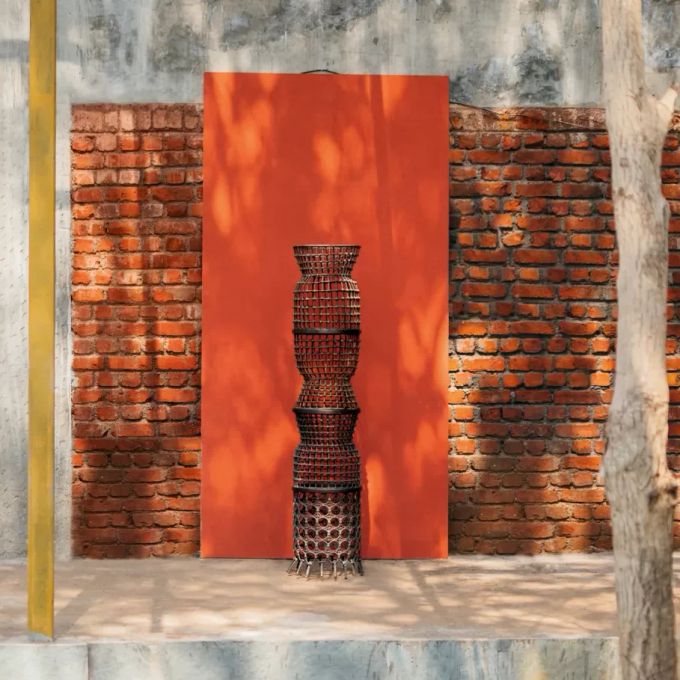
Our studio takes the greatest artistic freedom to express valuable concepts and fantastic stories in projects without limitations. These works inspire us, allowing us to share ideas and narratives. At the same time, this drive often results in products that enter production. For our Lace Fence design, we established a socially oriented production facility in India in 2006, which now provides 75 families with healthcare insurance, pensions, and a healthy working environment.
We love to cross boundaries: between dream and reality, between today and tomorrow. The possibilities to shape the future with the tools of today are endless, and we strive to use them to their fullest. Industrial production is as beautiful and inspiring as craft. We approach the design of serial products with the same care and attention as one-offs.
We are storytellers—from fantasy to factory, from statement to product.”
—Verhoeven Twins