23 March 2026
Ane Christensen: A Legacy Preserved Through Jewellery
As the Copenhagen-born artist’s works go on display at Carpenters Workshop Gallery London, she tells Head of Jewellery, Tamara Platisa, about the rings she's wearing, their role as vehicles for memory and how jewellery design has shaped her 25-year practice.
Share
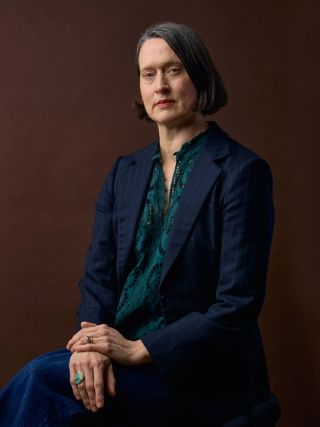
London-based artist and designer Ane Christensen is known for metalwork inspired by urban landscapes, optical illusions and negative space. She qualified at the Royal College of Art but was born in Copenhagen, which means the culture and light of Scandinavia have profoundly influenced her practice.
All of Christensen’s pieces begin with the simple geometry of cylinders, bowl forms and flat sheets, which she deconstructs through piercing, soldering and hand-forming. She works with metals including sterling silver, 18 karat gold, stainless steel, aluminium, copper and brass, recurrently exploring themes of light and balance.
Although prolific in sculptural and functional objects, Christensen sees powerful personal significance in jewellery – and her initial training in jewellery design has remained a constant driving force through her career, which has spanned 25 years. The metalwork artist sees it as a question of scale: she believes the same design principles can be applied to making a brooch or a ring as to making a sculpture or a wall piece.
“I love how jewellery can hold onto stories, memories and thoughts – it’s powerful.”
– ANE CHRISTENSEN
Tamara: Can you tell us about some of the jewellery pieces that you're wearing today?
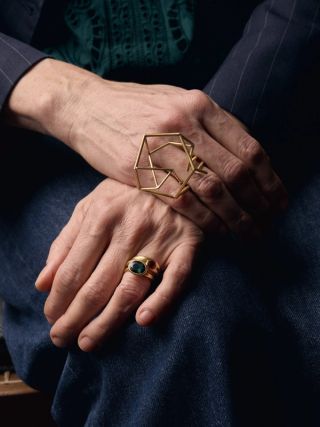
Ane: One is my wedding ring, made by the Danish jeweller Kamilla Ruberg who's a good friend of mine – it's made from Fairtrade gold. The second is my engagement ring, made by the Australian jeweller Mark Nuell, whose father ran his own modest sapphire mine. Unlike unconventional blue sapphires, Australian sapphires have green, teal and olive tones.
The third ring contains a ruby that belonged to my father's father, who grew up in rural Denmark but went to the US as a labourer, like many young men did at the time. His fiancée, my grandmother, waited for him for five years. When he came back, one of the things he brought back was a tie pin with this ruby in it. For me, this stone now represents his spirit of adventure but also the sense of hope, duty and belonging that kept him tied to my grandmother; all these ideas live in the ring.
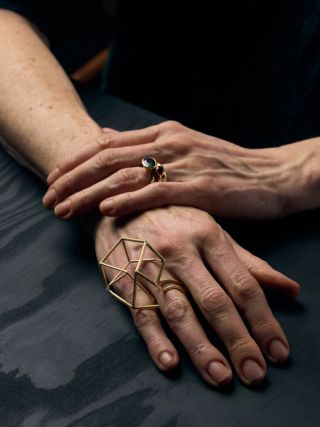
Tamara: That ruby ring seems to carry a lot of significance – has this meaning of this piece evolved for you with time?
Ane: Over the years, I've come to understand the sacrifices my grandparents made. For five years, they communicated through letters sent by boat across the Atlantic. They had real trust and faith in each other, as well as perseverance and resilience – the ring reminds me of these old-fashioned values.
Tamara: Do you think these jewellery pieces influence how you feel when you wear them?
Ane: Maybe a little bit. Wearing work by other makers feels effortless, in a way – free from the criticism or judgment that I might feel if wearing my own work.
Tamara: Although they're made by other people, do they also reflect your own work in any way?
Ane: They're quite simple, the colours and settings are quiet – and that's my aesthetic too. I grew up in Protestant Scandinavia, which has a pared back, less-is-more kind of culture, which I think stayed with me to some extent. I think all of my work has a sort of quietness to it. Similarly, with these rings I'm wearing, I don't really need anyone else to notice them – they're for me.
Tamara: And are you wearing any of your own creations today?
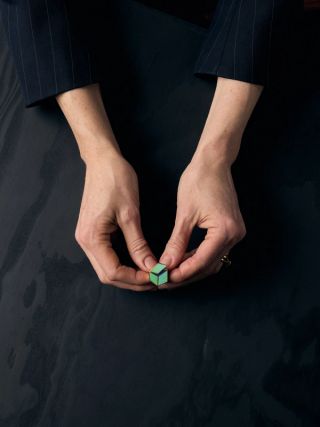
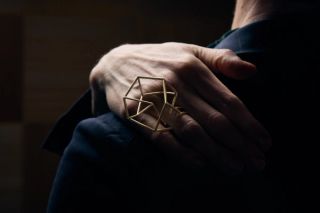
Ane: Yes, a brass ring I made during my early stages developing a jewellery series for Carpenters Workshop Gallery. It was never realised as a fully formed work, so it's more like a prototype – but it did lead to larger wall pieces that I'm still making. It shows how even unfinished pieces can push my practice forward.
“The thing that I've always known is that metal is my material – and that's never going to change.”
– ANE CHRISTENSEN
Tamara: How did you first get into jewellery making?
Ane: I have always been a maker – it just took me some time to work out what kind of maker. I made all sorts of stuff throughout my childhood; I thought maybe I should be a painter or fashion designer. When I was 18, I heard of someone from my school doing a jewellery apprenticeship and I remember thinking that would be the perfect combination of artistry, business and working with people.
Tamara: Did you feel like an artist at the time?
Ane: Fine art felt too scary, too big a jump. I'm not a fine artist, as such, but I guess I call myself an artist or maker working in metal.
Tamara: Was there ever a period in which you stopped making jewellery?
Ane: I stopped when I went to the Royal College of Art to do a Masters. It was a two-year course, and I had to decide between jewellery or larger-scale objects. The latter was the scarier choice – so, I went for it.
Tamara: Despite that change in direction, did jewellery design remain with you in some way?
Ane: Jewellery is still very close to my heart. My first training was in jewellery design – so, even though I've now had a 25-year practice of making objects and sculptures, I still think like a jeweller. The techniques I use and apply are jewellery techniques, just blown up in scale.
You could say that I now make jewellery for spaces, walls and gardens, instead of for the body. Shifting between different scales in that way – from jewellery to larger wall sculptures – can really stretches a creative idea.
Tamara: If your jewellery could speak, what do you think it would say about your life?
Ane: To me, jewellery fulfils two equally important purposes: it can be sculptural and decorative, bringing enjoyment and expressing our personalities; equally, it is a tiny reminder about events and people in our lives, which we carry around with us. If my jewellery could speak, I think we would have an interesting conversation about the past, the future and belonging.
Share
Exhibitions
More to explore
June 2026
Kayo Saito: Bonds Between Makers And Wearers
The Kent-based jeweller speaks to Carpenters Workshop Gallery’s Tamara Platisa about the creative possibilities that first drew her to jewellery design, the feelings evoked by the natural landscapes of her native Japan and how she negotiates the relationship between wearability and artistic concept.