Jean Prouvé 'Petite Potence' Wall Lamp (Yellow)
Price on request
Historical Design
circa 1955
Lacquered Metal, Light Fittings
4 x 35 x 104 cm
1.6 x 13.8 x 40.9 in
Jean Prouvé has become a leading figure in the history of design and has worked alongside Le Corbusier, Perriand, and Mallet-Stevens. Famous for applying industrial technology and processes to architecture and interior design without sacrificing aesthetic qualities, he developed the flattened tube technique, which increased furniture's resistance, stability, and lightness. Prouvé designed the first version of the ‘Potence’ bracket light for his own home in Nancy in the 1940s. It consisted solely of support fixed to the wall, enabling the pivot of a light tube tensioned by wire. A single light bulb finishes the arm. It was rapidly produced in various sizes, simple, clean, and functional. The ‘Petite Potence’ is a smaller version with similar proportions. Its compact dimensions were ideal for small spaces. The model was used for the equipment of the Air France housing unit in Brazzaville, Congo.
Literature:
P. Suzler, Birkhäuser (ed.), Jean Prouvé: Œuvre Complète/Complete Works, Volume 3: 1944-1954, Basel 2005, pp. 168-169, fig. 1144.
Location: Paris
Artist
Jean Prouvé
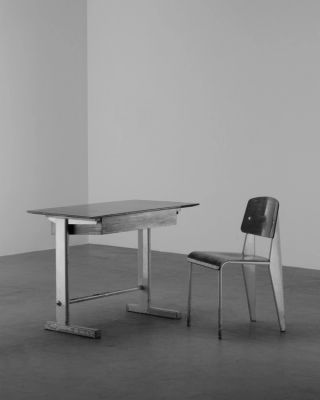
Jean Prouvé (1901-1984) was a French metal worker and pioneering architect. He played a major role in the development of systems of mass production in post-war modernism. He began designing in 1924 after working in metallurgy and built his own factory in 1945 in Maxéville. Prouvé taught at the Conservatoire National des Arts et Matières and was elected a member of the Academy of Architecture in 1972. He built the Musée des Beaux Arts du Havre from 1951 to 1962.