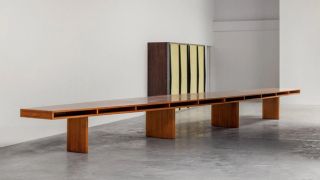
Jean Prouvé Structure Nomade 1957
Price on request
Historical Design
1957
Wood, Metal, Glass
1754 x 335 x 870 cm
690.6 x 131.9 x 342.5 in
This “nomadic structure” is an example of Jean Prouvé’s groundbreaking modernist innovations and a testament to his philosophy that design can be used to better society.
In 1957 Prouvé had already dedicated more than a decade of his life to the study and construction of prefabricated structures, seen especially in his 6x6 houses made for the homeless in Lorraine and Franche-Comté. He continued to search for new forms, while still using his preferred materials of metal and wood, in the creation of larger structures. Working with the engineer and architect Serge Ketoff, he designed three modular structures to house a temporary school in Villejuif, a suburb of Paris.
Simplicity was a key element to Prouvé’s design. Made of wood and metal, with open sides, the structure has a light and airy feeling. Always guided by function, the structures were created to be assembled and disassembled, giving a sense of ease and adaptability to the design. The use of an asymmetrical post in the structure revolutionized prefabricated architecture, expanding the design possibilities and functions for these works.
The provenance of this work adds another level of interest to the structure. Differentiated by its vivid blue paint color, it was first installed with two other nomadic structures in 1957, to house a temporary school in Villejuif. In 1958 one of the three structures burned down, and the other two were disassembled. In 1967 Maurice Silvy, an architect who had worked with Prouvé, used part of the structure for his office in Massy. In 2008 the office was set to be demolished. Thankfully, the nomadic structure was saved in time, after which it was restored. CWG acquired the work from this owner. Over fifty years later, the structure remains in excellent condition.
A truly exceptional work, this masterpiece by Jean Prouvé exemplifies his aesthetic and philosophical breakthroughs as well as his constructional and technical prowess. The result of decades of work developing the best prefabricated models, the structure captures the designer’s progressive and humanist spirit that he relentlessly applied to his work.
Artist
Jean Prouvé
Jean Prouvé (1901-1984) was a French metal worker and pioneering architect. He played a major role in the development of systems of mass production in post-war modernism. He began designing in 1924 after working in metallurgy and built his own factory in 1945 in Maxéville. Prouvé taught at the Conservatoire National des Arts et Matières and was elected a member of the Academy of Architecture in 1972. He built the Musée des Beaux Arts du Havre from 1951 to 1962.