17 April 2026
Forms That Remember: Jewellery as Structure, Memory and Transformation
What if jewellery is not something we wear, but something that remembers for us? In this essay, Bianca Blanari explores how it becomes an intimate archive, carrying personal and cultural histories over time.
Share
Against the skin, these small objects gather what life disperses: memory, migration, lineage, labour, devotion. Jewellery compresses experience into matter, concentrating time and emotion into a form small enough to rest against the pulse. It is sculpture that moves with the body, carrying traces of those who made it, those who wore it, and those who will inherit it.
Across the works of Alice Cicolini, Ane Christensen, Sonia Delaunay and Hermien Cassiers, jewellery emerges not as adornment but as a form of thinking. Each artist approaches the medium through a different language: pattern, erosion, colour or mathematical structure, yet all recognise that jewellery reorganises the relationship between object and body. These works do not embellish the wearer, they alter how the body inhabits space. They transform memory into form.
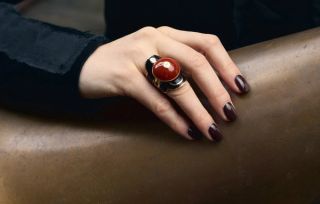
In Alice Cicolini’s Red and Black Ring (2019), structure itself becomes a metaphor for identity. Composed of three individual rings that may combine into a single form or separate into independent elements, the object resists a simple definition. When assembled, the pieces align into a domed composition crowned by polished gold, its surface animated by enamel markings— dots, lines and subtle geometric gestures that introduce rhythm across the metal.
This modular structure reflects Cicolini’s ongoing dialogue with pattern as cultural language. In her work ornament operates as a carrier of history rather than mere embellishment. Patterns travel across generations and geographies, encoding migrations, encounters and acts of transmission.
“Colour radiates outward, subtly altering posture and presence. Geometry becomes propulsion, colour becomes pulse.”
The ring therefore becomes an heirloom in motion, capable of transformation through the gestures of its wearer. Jewellery, for Cicolini, is never static. Objects gather energy through contact with the body and through the lives they accompany. Over time they become something else entirely: intimate portraits of the self.
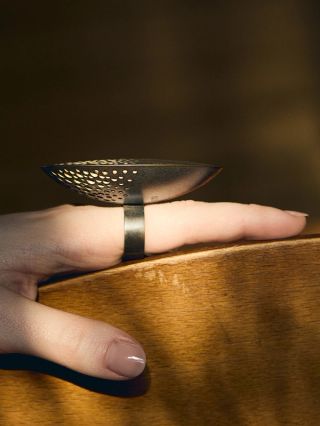
Another register of memory appears in the work of Ane Christensen, where form seems suspended between solidity and disappearance. Her Shallow Ring (2021) rises above the finger as a darkened brass disc, its surface pierced by irregular openings that reveal flashes of gold beneath. These perforations allow light to travel through the object, transforming it into a shifting landscape of shadow and luminosity.
Christensen approaches jewellery with the sensibility of a sculptor. Rather than imposing form upon the material, she cuts, pierces and gradually coaxes metal into shape, allowing the object to emerge through process. The result carries a quiet sense of erosion, as though the surface had been shaped by time itself. What appears solid reveals unexpected fragility, what appears absent becomes a source of illumination.
This tension between presence and loss echoes Christensen’s reflections on inheritance. Jewellery accompanies the body through the ordinary passages of life, accumulating meaning through use rather than display. Rings are worn daily, touched unconsciously, marked by time. Their value lies not in perfection but in endurance. In Christensen’s work, matter becomes a witness to life’s slow transformations.
Movement, rather than erosion, defines the jewellery of Sonia Delaunay. A central figure in the development of Orphism alongside Robert Delaunay, she believed that colour itself could generate rhythm, emotion and spatial dynamism. These principles, first explored through painting and textiles, find a strikingly intimate translation in her jewellery.
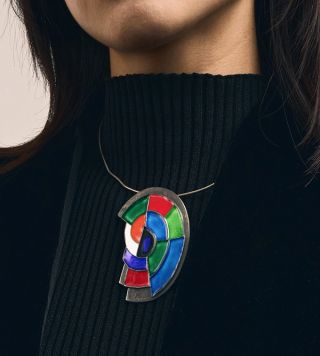
The Abstraction Pendant (1979) distils this philosophy into enamel and silver. Curved segments of crimson, cobalt, emerald and white interlock within a gently arcing frame, forming a composition that appears to expand outward from its centre. Each colour advances and recedes against its neighbour, producing a sensation of visual rotation.
Worn at the collarbone, the pendant becomes kinetic. Delaunay transforms the language of modernist abstraction into something lived and bodily, allowing the rhythms of painting to circulate through the intimate space of the body.
Precision takes yet another form in the work of Hermien Cassiers, where jewellery unfolds through disciplined systems of line and repetition. Her BI Bracelet (2019) forms an extraordinary lattice of interwoven gold wires, thousands of filaments intersecting to create a structure that resembles a mathematical field brought into material existence.
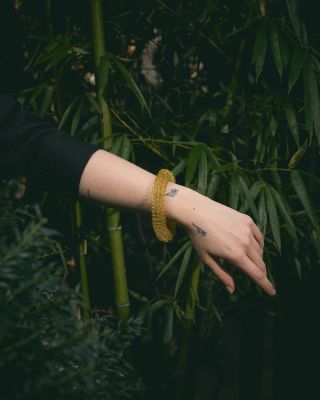
Cassiers’ practice is deeply informed by material research. After studying with the Italian goldsmith Giovanni Corvaja, she developed her own alloy of gold capable of sustaining extreme torsion while remaining flexible. Each wire is drawn, folded and woven repeatedly until the metal begins to behave like fabric rather than rigid structure.
“Light filters through the lattice, shadows move across the skin, and the structure adapts gently to the movement of the wrist.”
What initially appears dense and architectural becomes unexpectedly supple once worn. Mathematics, here, does not produce rigidity. Instead it reveals a quiet intimacy: a system of lines capable of breathing with the body.
What binds these artists is not aesthetic similarity but philosophical depth. Each understands that jewellery possesses a rare ability to transform experience into form.
Pattern becomes lineage.
Colour becomes pulse.
Structure becomes shelter.
Process becomes devotion.
Memory becomes inheritance.
Jewellery remains one of the few art forms that survives through intimacy. It lies against skin, absorbs warmth and scent, and accompanies the body through moments both ordinary and profound. It carries celebration and grief, migration and belonging. Over time the object becomes more than itself. It gathers biography.
The energy of the maker meets the energy of the wearer, and the exchange deepens through years of contact.
If these jewels could speak, they would not speak of vanity. They would speak of journeys across continents, of patterns carried through generations, of colour that insists on movement, of metal pierced until light can pass through it, of gold drawn into impossible structures. They would speak of memory given weight. And here the loop closes.
Inheritance becomes structure.
Structure becomes colour.
Colour becomes process.
Process becomes memory.
Memory returns to the body.
The jewel comes alive. And so does she.
Share
Exhibitions
More to explore
June 2026
Living Forms: When Jewellery Begins to Breathe
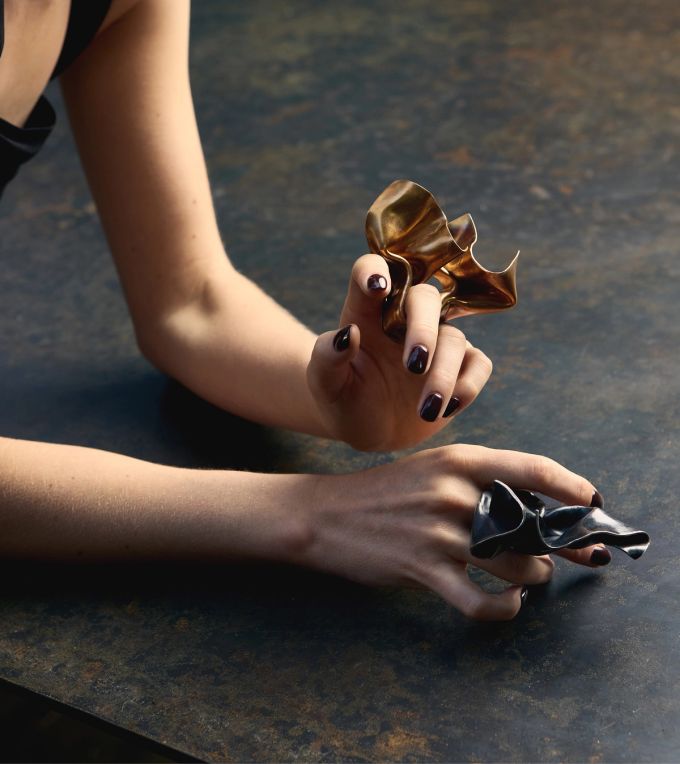
What happens when metal begins to behave like life? Jewellery has long been understood as an object of permanence: precious materials shaped into forms meant to endure. Yet in the hands of many contemporary artists, metal resists this stillness. It folds, grows, trembles, gathers memory, or assumes the quiet presence of living companions. These works do not remain inert ornaments resting upon the body. They move with it, respond to it, and at times seem almost to breathe beside it.