2 June 2026
Kayo Saito: Bonds Between Makers And Wearers
The Kent-based jeweller speaks to Carpenters Workshop Gallery’s Tamara Platisa about the creative possibilities that first drew her to jewellery design, the feelings evoked by the natural landscapes of her native Japan and how she negotiates the relationship between wearability and artistic concept.
Share
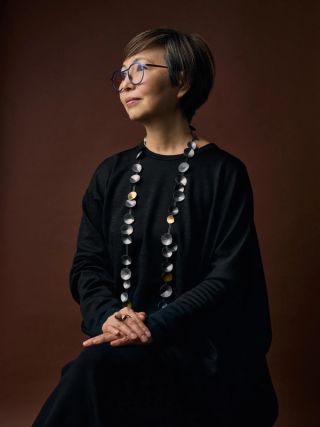
Through carefully chosen materials and aesthetics, jewellery designer Kayo Saito creates delicate, sculptural shapes inspired by fragility, poetry and the energy of plants. Born in Japan, the artist draws influences from her homeland ranging from haikus and lotus ponds to traditional calligraphy and screen paintings from the 17th-century Rinpa School.
Saito’s fascination with the variety and freedom of expression offered by contemporary jewellery took her from Tokyo to London in the late 1990s. Studying at the Royal College of Art, she mainly worked with paper to create lightweight sculptural jewellery that swayed with the movements of the body. Soon, she moved on to work with precious metals.
Whether through old family heirlooms or bespoke contemporary pieces, Saito believes that jewellery can carry identity, memory and individuality – and, over the past two decades of making jewellery, she’s found a way to reconcile the differences between an artistic desire for concept and the practical needs of a wearer.
Tamara: Can you tell us about a piece of jewellery you’re wearing today and what it means within your practice?
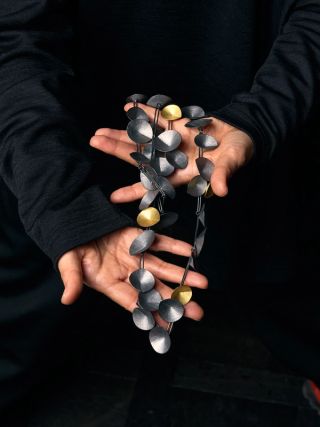
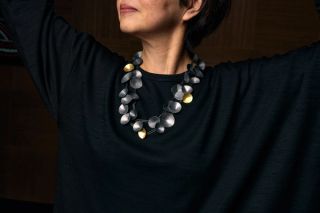
Kayo: Most of the time, when I work, the image comes first, or some drawing comes first – but for this long necklace that I’m wearing today, I really wanted to focus on the material first.
For example, I've been thinking about what ‘sustainable’ really is and what has less impact on the world. I started thinking about what kind of things I can do as a maker. To me, recycling is key. So, this necklace is made of recycled materials – the silver and the gold are offcuts from my other works, which I had kept in a pot for a long time.
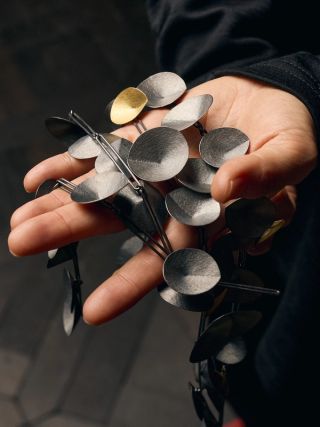
Another thing I thought was what I could do to minimise waste material, so I stretch the metal using a milling machine, instead of cutting it. The circle you see in this necklace involved no cutting – it's a stretched form, using a milling machine. And then I just minimise the shape, cut the little slit and fold it together.
Tamara: What inspired you when creating the design of the necklace?
Kayo: I'm always inspired by nature. When I was experimenting with the design of this necklace, a lotus came into mind. That's something I experienced while visiting temples in Japan – I went a couple of times in the really hot summer. Walking into the temple gate, the lotus pond welcomed us, with such fresh, green layers.
The layers of a lotus swaying in the wind was, to me, calmness and purity. The lotus has that meaning in Buddhism as well – it's a very important plant. So, the necklace has a very simple, leafy shape, which is quite me.
Tamara: You’re also wearing a ring with a very interesting stone in it – can you tell us about it?
Kayo: It’s a smoky quartz – carved and then put together by me. I started carving stones myself – semi-precious stones, not very expensive stones. It's a new technique I learned maybe five years ago. I'm still developing, still practicing, finding the right materials – but it's fun because you can also add in colours, adding more uniqueness to the work.
This smoky quartz stone has a kind of power to it. It's nice to set it onto your skin – that's the idea, rather than wrapping it in the metal. If you don't touch the stone itself, it’s like a waste to me. That's why I wanted to make rings with the stone resting on your skin. It’s like a connection that I can make more powerful.
Tamara: How did you first get into jewellery design?
Kayo: I never thought I’d become a jeweller. I quite liked sculpture and I loved making something three-dimensional – but it didn't have to be jewellery. I am more interested in form and the creation process.
I studied metalwork in Japan. I came to the UK because I really loved the freedom of thinking in contemporary jewellery here – that's something that was lacking from my education in Japan. And then, I wasn't sure between jewellery or silversmithing. I did both at first but then realised that jewellery can be more versatile. I was really drawn to its possibilities, which are much broader than silversmithing – almost like a fine art.
“A work can finally become jewellery, even if it wasn’t from the beginning.”
– Kayo Saito
Tamara: How has your approach to jewellery design changed over the course of your career?
Kayo: As a student, I wanted to experiment with different materials, sizes and applications. I was using paper at that time. How to wear the jewellery was what came last – it was more about trying to put my concept or my thinking into the piece. Gradually, the wearer was at the back of my head. My sizes went down to more wearable sizes. I started thinking more about how comfortable or how realistic it was to wear the pieces.
In a lot of contemporary jewellery, I must say, the wearable side is not important. But I’ve kind of passed that point. Jewellery is a part of body, and the joy is to share with customers. That's something that's changed over the past 20 years.
Tamara: Is jewellery more than just an object?
Kayo: The difference between an object and a piece of jewellery is identity and memories. Jewellery can be accumulated and passed on to the next generation. It's really interesting because I make jewellery but then once the client buys it, it becomes part of that person's identity. So, it's like an exchange. This is the beauty of being a jeweller.
Tamara: What’s a significant piece of jewellery that’s been gifted to you?
Kayo: It's a family heirloom. When I was 20, my grandmother took me to a jewellery shop in Japan and said to choose the ring I wanted. I chose a ruby and diamond ring. I still have it in my box – but it's not my style at all! For your first ring, you have no idea what to choose. The shop assistant brought me all these different rings, so I was completely dazzled and I didn’t know what to do. At the same time, I could never throw it away because it was my grandmother’s gift to me. It's about the experience I had with her and also my first experience with jewelry.
Share
Exhibitions
PAD Saint-Tropez 2026 Ingrid Donat | Aki+Arnaud Cooren | Roger Herman
Saint-Tropez
|2 Jul – 5 Jul 2026
More to explore
March 2026
Ane Christensen: A Legacy Preserved Through Jewellery
As the Copenhagen-born artist’s works go on display at Carpenters Workshop Gallery London, she tells Head of Jewellery, Tamara Platisa, about the rings she's wearing, their role as vehicles for memory and how jewellery design has shaped her 25-year practice.